
Statistics & Impacts
Platform Strength & Capability Indicators
CHALLENGES
Core challenges confronting today’s academic publishing ecosystem
Today’s academic publishing landscape is burdened by fragmented workflows, manual-heavy processes, prolonged review cycles, limited visibility, and growing compliance demands—significantly impacting editorial efficiency, publication quality, and institutional scalability.

The fundamental issues disrupting efficiency, governance, and growth in academic publishing
Addressing these challenges through a unified, end-to-end publishing ecosystem that digitizes and automates the entire scholarly lifecycle—enabling institutions and publishers to centralize operations, enforce governance standards, accelerate editorial workflows, and scale securely across journals, conferences, and publishing programs.
Benefits
Platform Capabilities & Functional Excellence
Delivers a comprehensive, enterprise-grade capability framework that unifies manuscript submission, peer review, editorial governance, publishing operations, and analytics within a single intelligent platform—enabling institutions and publishers to standardize workflows, automate critical processes, strengthen compliance, and scale seamlessly across journals and conferences.
Rolebased Dashboards
Automated Notification System
Intelligent Manuscript Tracking
Configurable Workflow Rules
Journal Branding & Configuration
Editorial Decisions
Peer Review Management
Secure Platform
Advanced Features
API Integrations
Seamless External Connectivity ScholarNote supports robust RESTful API endpoints that allow secure data exchange with third-party applications, including institutional repositories, ORCID, plagiarism engines, and analytics platforms, to streamline workflows and eliminate manual data entry.
Plagiarism Detection
Automated Originality Assurance An integrated plagiarism engine performs real-time similarity checks across global academic databases, institutional archives, and internet sources, delivering match reports with severity scoring and inline source comparison to uphold research integrity.
Semantic Search
Contextually Intelligent Retrieval ScholarNote’s semantic search capability goes beyond keyword matching by leveraging natural language processing models to understand intent and context, enabling researchers and reviewers to find relevant manuscripts, references, and author profiles with high precision.
Manuscript Lifecycle Management
End-to-End Workflow Orchestration Manage submissions from initial upload through peer review, revision cycles, and final publication tracking complete with automated task assignments, revision history logs, and configurable workflow rules.
Reviewer Matching Engine
AI-Driven Reviewer Allocation An advanced algorithm evaluates manuscript topics, reviewer expertise, past performance, and conflict-of-interest criteria to recommend the most qualified reviewers, thereby reducing assignment time and improving review quality.
Role-Based Dashboards
Personalized Role-Centric Views Dynamic dashboards tailored to specific user roles (Author, Reviewer, Editor, Admin) display real-time KPIs, pending actions, alerts, and metrics, enabling faster decision cycles and improved accountability.
Collaboration & Annotation Tools
Interactive Peer Engagement Inline commenting, version-aware annotations, and threaded discussions let reviewers and authors work together right in the manuscripts, keeping everything clear and making the revision process easier.
Advanced Reporting & Analytics
Data-Driven Insights Generate custom reports on submission trends, review turnaround times, reviewer performance, journal metrics, and compliance statistics with export options (CSV/PDF/API) for institutional dashboards.
Role & Permission Governance
Enterprise-Grade Access Control Fine-grained RBAC (Role-Based Access Control) policies empower administrators to enforce strict security postures, define permission scopes, and audit access trails for compliance and risk management.
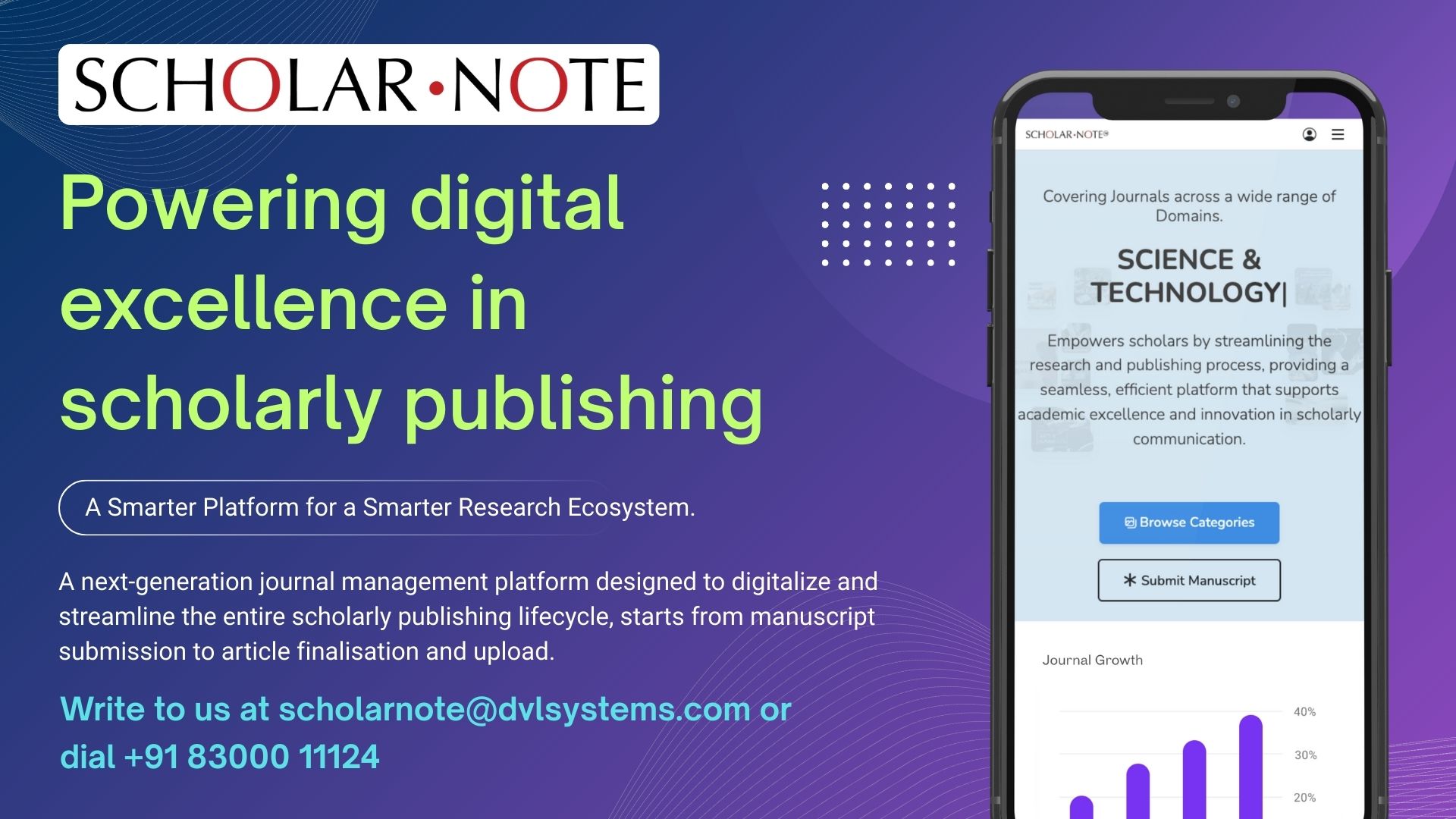
ScholarNote is a comprehensive Journal Management System designed to manage and automate the complete scholarly publishing lifecycle, from manuscript submission to editorial decision-making and publication workflows.